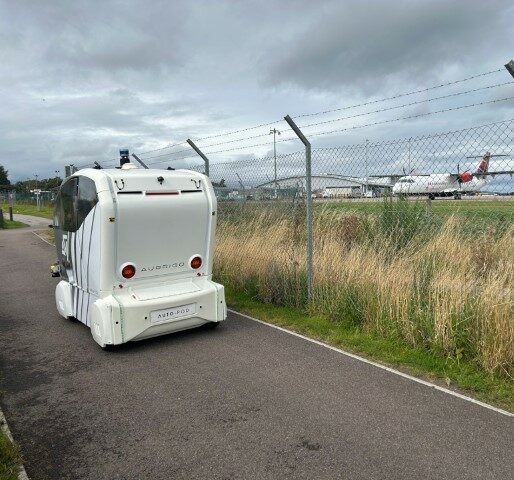
An exciting week long trial at Inverness Airport gave passengers the opportunity to ride in an autonomous Auto-Pod from the new rail station to the airport terminal. This was followed by another week-long trial of a larger Auto-Shuttle at the University of the Highlands and Islands Inverness Campus, which was popular with students travelling around the campus.
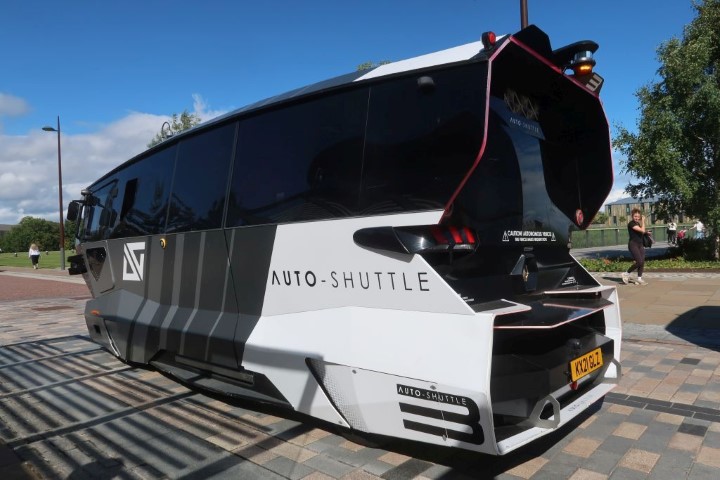
The distance from the airport railway station to the terminal is 1.2km, and the Auto-Pod was able to cover about 750m of the journey by following an active travel route round the airport perimeter. Currently, the alternative for passengers is to walk the whole route or take a service bus for which there is a charge. The autonomous vehicle trial was being used to explore the potential of a vehicle connection for passengers travelling between the railway station and the terminal building.”
This trial also helped to gauge public perception surrounding autonomous vehicles and will assess the feasibility of introducing an on-demand, low-cost connected and autonomous vehicle (CAV) service to the region. By leveraging autonomous vehicle technology, the project aims to enhance accessibility, reduce passenger travel times, and significantly decrease CO2 emissions, contributing to Scotland’s NetZero goals.
Project partners include the University of Glasgow, the Highlands and Islands Transport Partnership (HITRANS), Aurrigo International plc, Stagecoach North Scotland, and Darwin Innovation Group Ltd., and is funded through Innovate UK and the Centre for Connected and Autonomous Vehicles (“CCAV”) Commercialising Connected and Automated Mobility (“CAM”) competition.
The continuous progress in Connected and Autonomous Vehicles (CAVs) technology presents new opportunities to address pressing challenges in transportation, particularly in regions like the Scottish Highlands and Islands.
However, realising these opportunities requires sustainable and responsible business models that can navigate ethical, social, and economic dimensions.
The University of Glasgow Adam Smith Business School, in collaboration with HITRANS, is spearheading an initiative to explore how CAV technology can be leveraged to deliver value for stakeholders and address some of the challenges faced in this unique region.
A follow up workshop was held in Inverness Town House to guide participants through a structured process to define and prioritise the challenges and opportunities in the region, followed by an exploration of to what extent CAV services might be able to address these challenges and create value. The goal is to support stakeholders in designing innovative business model prototypes, articulating hypotheses and propositions to test their ideas, and identifying and mitigating potential risks.