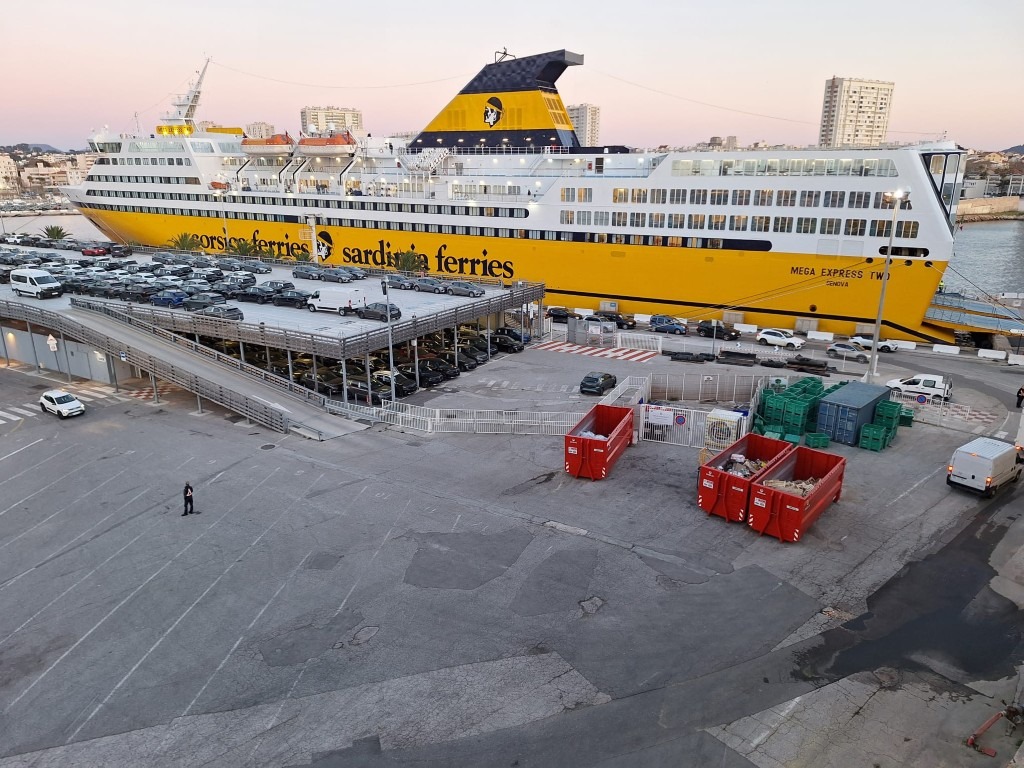
Photo: Corsica Ferries ship at Toulon
As last year, SNCF in January were offering TGV fares on their Ouigo services from just €19 – available on just one day and valid for travel until the end of March.
In 2025 I travelled for €19 from Paris to Nice and €29 from Nice back to Paris. In between I went to Turin via Cuneo and then returned to Nice via Milan, Cremona, Genoa and Diano Marina. The latter no longer has a station in town as the coastal line has been abandoned for a faster alignment a few kilometres inland. But it’s where in the 1980s, on my way by train to Istanbul for the first time, I had met up with my mum and dad who were on holiday there with the Railway Touring Club – an organisation which arranged rail holidays for railway staff.
This year I thought that I would go back to Corsica. So, I bought a €29 ticket from Paris to Toulon and a €19 return from Nice to Paris. And the Corsica Ferries tickets were great value as well – just under €86 each way with a cabin to myself, a 3-course meal in the cafeteria and, of course, my overnight voyage of 11h45m from Toulon to Bastia and 11h from Ajaccio to Toulon.
I caught the Caledonian Sleeper to London and then the Eurostar to Paris. In truth, I’ve never really liked the new Siemens Eurostar trains – high seat backs and at times seats right against a bulkhead with no view. Still, it’s a quick way of getting to the continent. The crush of passengers at St. Pancras is a bit off-putting as well – it can get very crowded in the waiting area there. It’s also like an airport experience in terms of having to arrive early for security and border checks – but these are hardly the fault of Eurostar.
Still, with the right apps on your mobile phone, it’s easy to get quickly across Paris on the RER trains. The Man in Seat 61 will show you the way!
It was quite a contrast from a cold and wet Scotland to a warm and sunny Toulon.
The ferry to Corsica was really quite impressive – the photo above shows the one adjacent to and identical to mine before leaving Toulon.
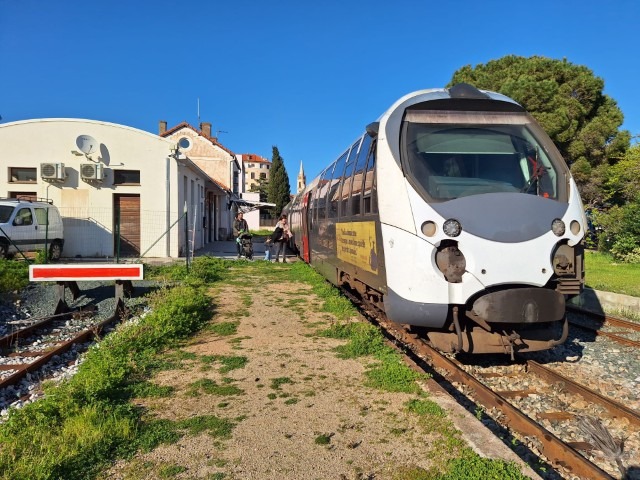
Photo: Corsican train at Calvi
The Corsican rail network is Y-shaped – running from Bastia in the north-west of the island to Calvi in the north-east via the junction south to Ajaccio at Ponte-Leccia. It’s narrow gauge – but high altitude (the summit at Vizzavona south of Corte is 906m above sea level. The mountain scenery is really quite spectacular.
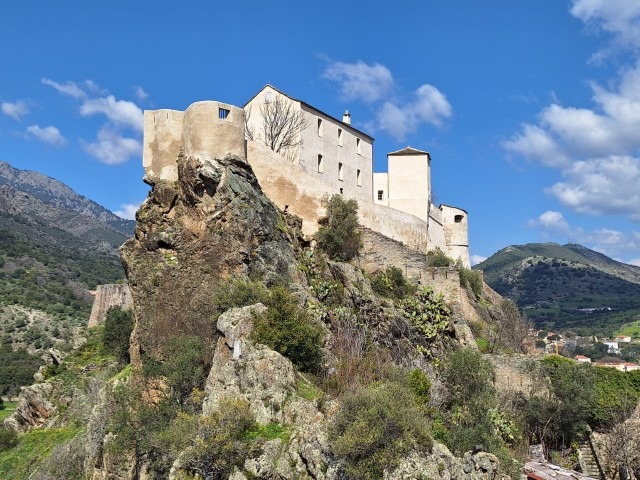
Photo: Corte
I also wanted to return to Bonifacio – right in the south of the island, facing Sardinia. It’s a small town with a great setting, its harbour sheltered by white limestone cliffs and with an ancient cobbled-street citadel above. There’s no train there – but one bus a day (except Sunday – which meant that I had to get there from Ajaccio a day earlier than I would have liked).
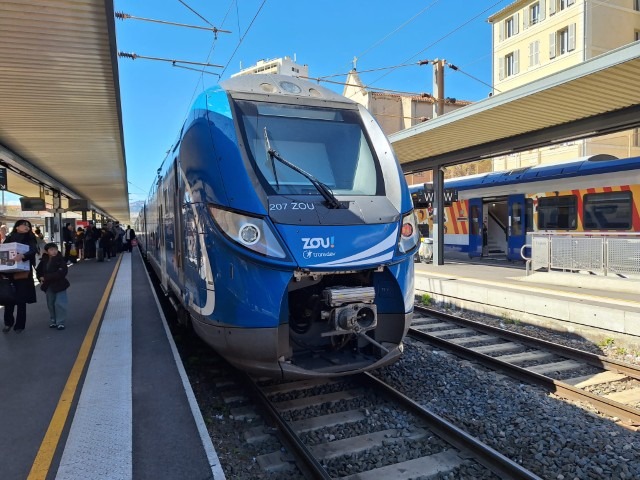
Photo: Local train – run by Transdev – at Toulon
Arriving back in Toulon, I caught the frequent bus to St. Tropez – which, like Calvi, was a bit quiet off-season. It’s a pleasant enough wee place with a harbour – but I wouldn’t rave about it.
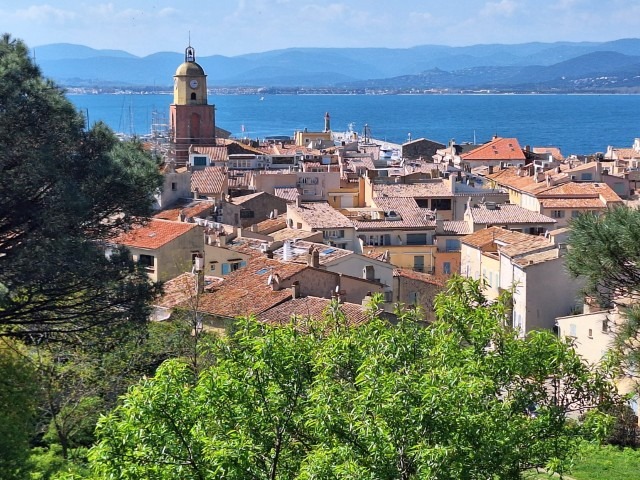
Photo: St. Tropez
I then caught the bus to St. Raphael to catch the local train to Nice.
However, my planned return trip to Paris the next day never materialised. A train had hit a lorry between St. Raphael and Cannes, bringing down the overhead wires. I got notice of this from SNCF while having my breakfast – and thought that, since the TGV was now starting from Toulon, I should be able to catch it there with six hours and more up my sleeve. It was not to be. There was no replacement bus – and I was directed to Nice airport to try to catch a coach from there to Toulon. That turned out to be a Flixbus service leaving Nice airport ten minutes before my TGV was leaving from Toulon! Back at Nice station, I caught a local train to Cannes – where the station staff were quick to point out that they were SNCF and I had a ticket for Ouigo (an SNCF company) and I should therefore ‘phone Ouigo or go online to seek assistance. I didn’t bother to point out that the line closure affected all trains! In the end, I had to spend the night in Cannes (poor me!) instead of in my expensive hotel (not refunded) near the Gare de Lyon in Paris.
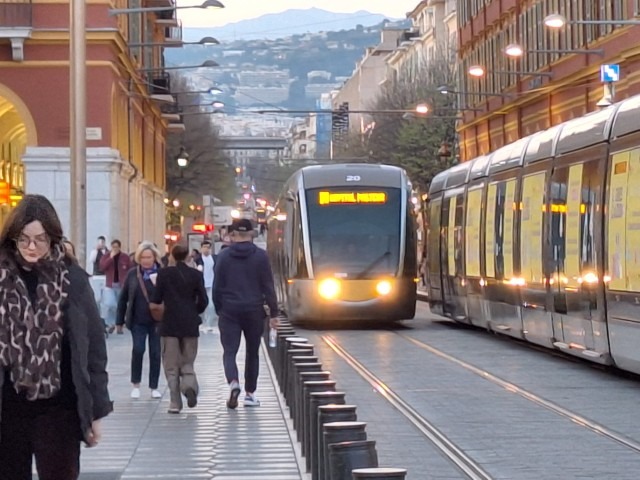
Photo: Nice
At first, news was that the line would re-open early the next morning – but next morning came a message that the line would stay closed until the early evening. So, having had to re-book my TGV to Paris by 3pm or else my fare would have been automatically refunded, I was now going to miss that re-booked TGV from Toulon unless I could get there by bus. However, as I found out the day before, where there are trains, there are no alternative buses! That’s integrated transport for you – courtesy of ZOU! in that part of France. I worked out a complicated series of local buses which would take 3h45m from the outskirts of Cannes, getting me to Toulon just over half an hour before the departure of my train to Paris. However, to get to the outskirts of town, I needed to catch a bus from the rail station – and to my delight and in spite of a message that morning saying that no alternative transport was being provided, it turned out that there was indeed a replacement bus service shuttling between Cannes and St. Raphael, taking just over an hour. My luck was in – and I made it to Toulon and hence to Paris for late evening and a hotel I had previously booked for a second night in Paris near the Gare du Nord.
All in all, I enjoyed being back in the south of France – and on Corsica. But, when things get disrupted, it struck me that the French were far worse at trying to help folk than has been my experience in Britain (though the lack of Lumo staff at Waverley – where LNER staff direct folk to Lumo’s Twitter/X account when things go wrong – echoes my experience in Cannes). The EU’s policies of rail liberalisation have spawned rail operators offering great fares such as those bought by me from Ouigo – but, equally, have separated train from track and given rise to a “not my problem, gov.” attitude to passengers in a disjointed railway. I don’t like Brexit – and I have some doubts about Great British Railways – but we are in Britain at least beginning to address the issues brought about by privatisation and a subsequently fragmented railway.
Lawrence Marshall
23 May 2026