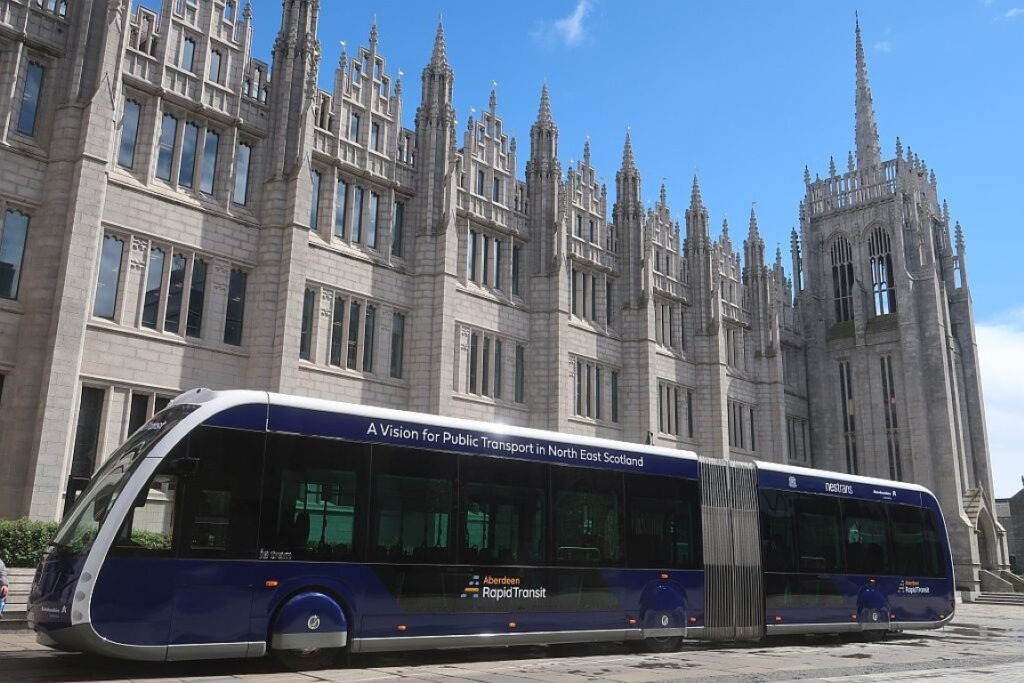
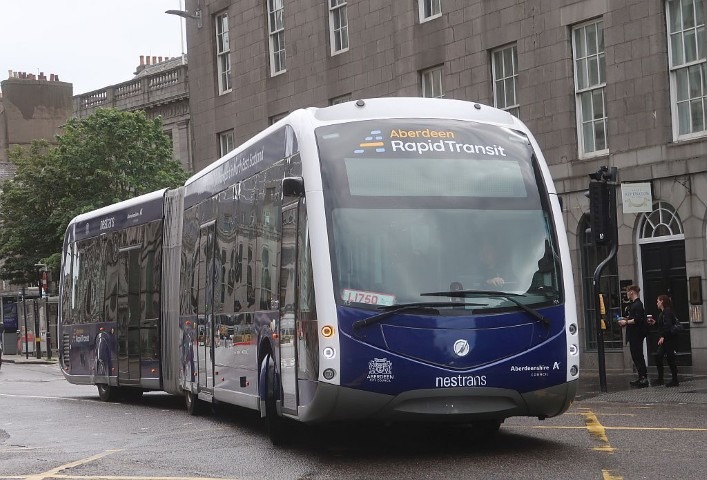
The striking demonstrator vehicle, which visually blends characteristics of both a bus and a tram, attracted head-turning public interest outside Marischal College as part of a week-long exhibition and initial route assessment across the area.
Several mass transit options, including heavy rail and tram, had been compared as part of the Regional Transport Strategy. Bus Rapid Transit was found to be the most appropriate, as it is flexible and the construction costs are less than those for rail or tram.
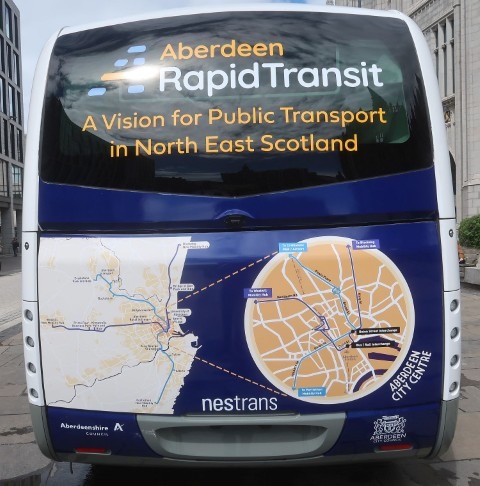
The vision for ART focuses on delivering a high-quality bus-based public transport system which seeks to deliver joined-up transport services, including connections with other public transport services, with walking and cycling networks, and with car through Park & Ride sites.
The visit was an important part of the ongoing development of the Outline Business Case for ART, supported by funding from the Aberdeen City Region Deal. It provides a practical way to show how a high-quality, zero-emission, tram-style vehicle could operate in practice, while helping the project team gather feedback and carry out practical testing along proposed routes. It also responds to earlier public and stakeholder engagement, which highlighted strong interest in the design and quality of future ART vehicles.
A report on a routeing analysis was presented at Aberdeen City Council’s Net Zero, Environment and Transport Committee in 2024, where it was agreed that the optimum network for delivery at this time is two cross-city routes:
- Blackdog to Kingswells / Westhill
- Craibstone P&R / airport to a new Portlethen Mobility Hub
Journey times can be made quicker and more predictable through a combination of improvements to infrastructure, vehicles and ticketing:
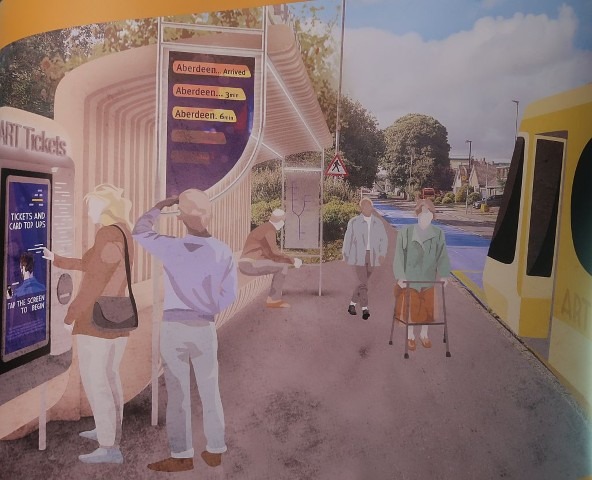
- Bus priority infrastructure which will help ensure that ART vehicles and other buses are less affected by delays caused by other traffic, e.g. dedicated bus lanes, priority signalling at junctions
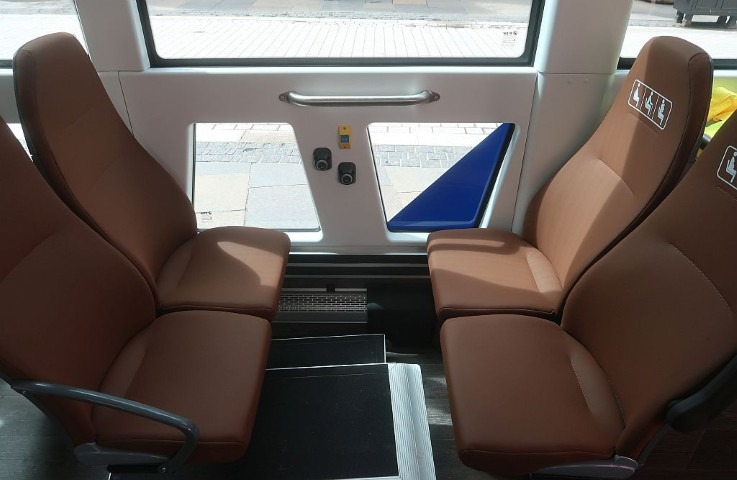
- Vehicles which have more doors in use (enabling passengers to get on and off more quickly) and provide level boarding at stops (which is quicker as well as easier for many people)
- Buying tickets before getting on the bus, or using electronic ticketing, which will mean that buses don’t need to spend as much time at stops.
The particular model of vehicle on show was a Spanish built ‘Irizar ie tram’, as is used by a number of operators across Europe for similar style rapid transit systems, including in Belgium, France and Spain. Other such vehicles are used in Britain for airport park and ride services. The Belfast Glider is a bus rapid transit system which operates through that city using similar vehicles from another manufacturer.
The demonstrator vehicle was electric and contains batteries mounted in the roof. These can be charged daily, or there is an alternative option for ‘opportunity charging’ at main stops using a pantograph system.
Other design features which are optional include the matching wheel covers to give a tram like appearance, and the low level glazed areas which have been a talking point elsewhere.
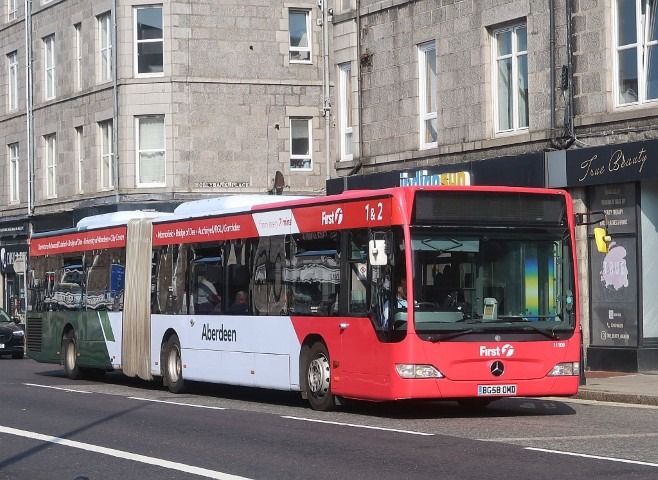
When the left hand drive 18 metre long demonstrator vehicle was being driven around Aberdeen on trade plates, the public were quick to notice the evolution of the articulated vehicle style, having become used to the previous generation of ‘bendy buses’ which were branded for the high frequency routes 1&2, and operated on cross city services up until a couple of years ago.
However ART is about the whole system, not just the vehicle. ART aims to deliver:
- Quicker, more predictable, and dependable journey times.
- New or extended bus lanes which reduce the effect of traffic jams on public transport, to benefit all bus services on these corridors and in the city centre.
- Modern bus shelters designed to enhance passengers’ experience including improved safety, comfort and information displays.
- A joined-up transport network providing improved connections across North East Scotland, improving access to jobs and other opportunities.
The overall aspiration for ART is to deliver a fast and efficient mode of public transport offering an alternative to car travel.
NW
5/6/2026