This article reflects my experiences of travelling on the Belfast Glider, an example of a Bus Rapid Transit project in the United Kingdom. This project does have a connection to Scotland. Back in February 2021, the Board for the regional transport partnership for Aberdeen and Aberdeenshire (Nestrans) received a presentation from a representative of the Department for Infrastructure, Northern Ireland, about the evolution of the Belfast Glider Bus Rapid Transit scheme.
It is an interesting presentation, in that it sets out the development of this project from high level commitment (2002) to its establishment as a flagship project (2015), which also included plans for using the transport project to aid the economic transformation of Belfast. The planners did consider both a bus based and light rail based options, but concluded that not only would light rail cost at least three times the estimate for a bus based solution, but that the passenger demand was not present to justify a light rail system. The bus based Belfast Glider took to the road in September 2018.
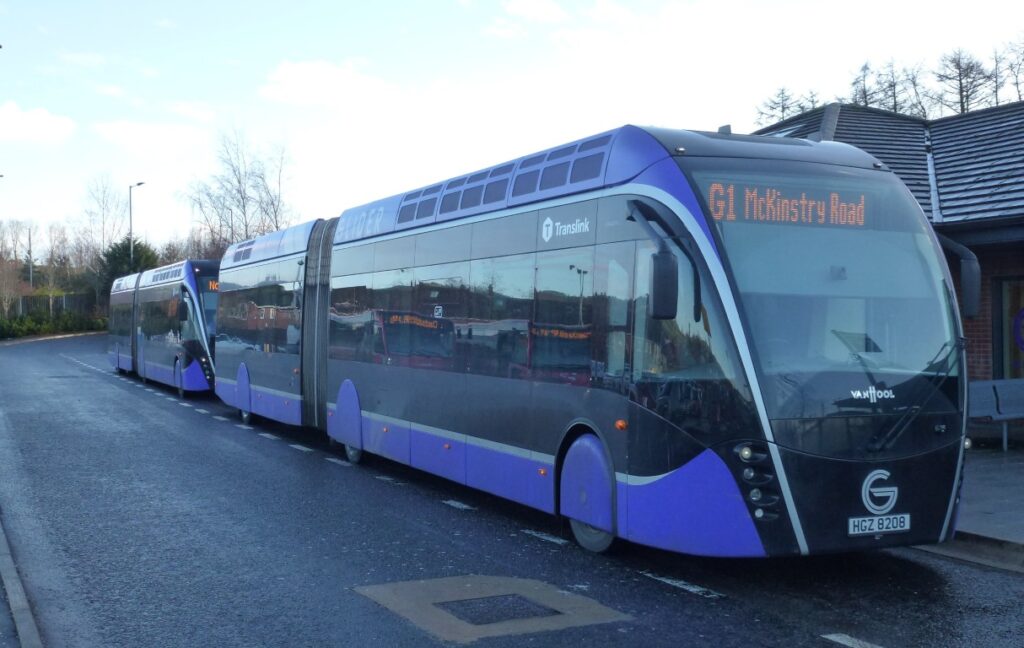
The G1 Glider at the Dundonald Park & Ride terminus.
The Belfast Glider system operates over 15½ miles on the two routes. Route G1 is distinct in that it runs across the City, from McKinstry Road in the West of Belfast to Dundonald Park & Ride in the East, some 13 miles. It is the only bus service that directly connects the two communities in Belfast. For that reason alone, the start of the Glider was a defining moment in the Belfast bus network. Route G2 starts from the city centre out to the developing Titanic Quarter, some 2½ miles away.
The Glider is operated by Translink, the arms-length public sector body which also operates the Metro and Ulster buses. The two Glider routes G1 and G2 replaced the existing Metro bus services, operating to and from the city centre (like most of the Metro services).
At the Translink information centre on Donegall Square North, opposite City Hall, I picked up a leaflet containing a system map of the Belfast Metro network; and the separate “line-drawing” route map for the two Glider services.
The first route that I took was on service G1, from City Hall out to Dundonald Park & Ride. The buses, as you will see from the photograph, are Van Hool Exquicity articulated vehicles. These are 18.6 metres long, 2.50 metres wide, and 3.30 metres high, according to the technical specification. They have four access doors, used for both boarding and alighting. The Belfast Glider has a seating capacity for 42 passengers; and a maximum of 63 including those standing. There is also capacity for one wheelchair (towards the rear).
This articulated bus does have a “tram-like” external appearance, notably because the tyres are covered, as though disguising steel wheels. This was self-evidently an intentional part of the Van Hool Bus Rapid Transit design, as is reinforced in the company’s publicity. It is interesting that the Northern Ireland authorities and Translink went with the articulated bus design, as in United Kingdom, we have not had that many successful experiences of such vehicles. In the mid-2000s, First Group tried with the “FTR Metro” brand in Swansea on Wright StreetCar articulated buses, which once again had a tram-like appearance, with covered tyres. That experiment was not wholly successful, according to reports from the local press. First also operated the Wright Streetcar in Leeds and York on various routes (Park & Ride in York) and on the interurban route (72) from Leeds to Bradford. These buses are no longer operating.
But back to Belfast, where the outcome for the Glider Van Hool Exquicity vehicles looks to be more positive. On the G1 route, the bus operates at a 7-8 minute frequency in the daytime, Monday to Friday. The bus halts for the Glider come with ticket machines (see photograph) and also have live times of the next bus, as well as hard copy timetables on the bus panels, along with the line drawing of the Glider network. I found the ticket machine easy to use and was able to buy a day ticket at £5.00 (cash or debit/credit card accepted). A ticket for a single journey (any distance) is £2.30, so the day ticket does represent good value for more than one journey; and allows for connections on other Metro bus services.
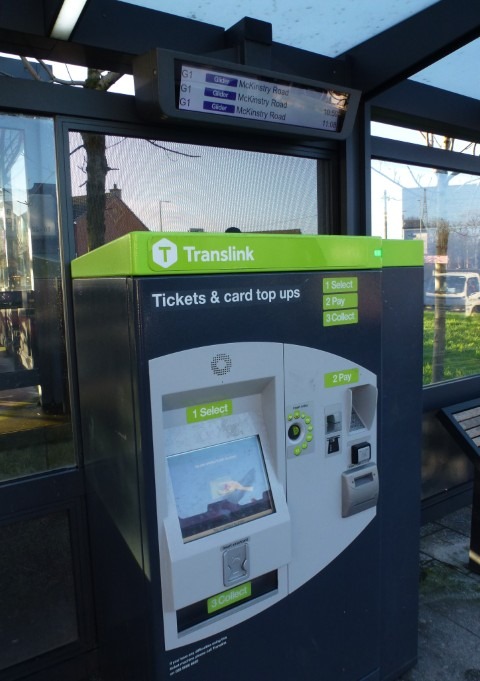
A ticket machine at a Glider bus halt. Above the machine are the live times of the next Glider services on route G1.
Revenue Protection Officers were on duty on the return trip from Dundonald Park & Ride, so I had to show my paper ticket on the bus. As there are multiple doors on the Glider you can board and alight the bus through any of the doors, as there is no checking of tickets as you get on. Just like on a tram, the driver on the Van Hool Exquicity is in a cabin sealed off from the passengers. The driver just drives the bus, rather than also being required to sell or verify tickets.
On board the Glider, there are overhead screens which indicate the next bus halt; and the subsequent two or three stops on the route. As the Glider approaches a bus halt, an automated voice announces the next stop. Line drawings of the Glider route and network are also affixed above the doors. Whilst stood at a Glider bus halt, I also noticed that as the vehicle approaches, a bell announces its arrival at the halt. All very helpful journey aids.
After a run out on the G1, it was time to sample the Glider out to the Titanic quarter on the G2. Unfortunately, however, I picked a time during the day (between noon and 3.00pm) when the vehicle frequency drops off to one every 20 minutes, from a bus every 10 minutes or so. Once I had visited the Titanic Quarter, I realized that this frequency probably reflects the fact that there are large tracts of land (brownfield sites) within this area which are yet to be developed: whether with research establishments, educational institutions, offices, residential properties or other commercial ventures. The Titanic Quarter does already have a mix of new buildings (as described above) but clearly not yet sufficient to justify an all-day 10 minute frequency of the G2 Glider.
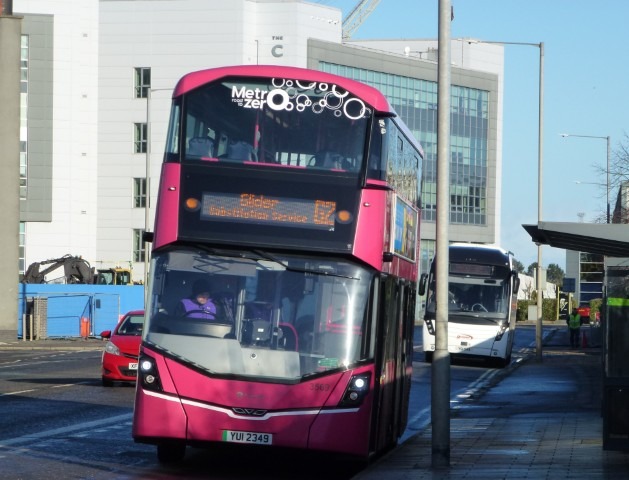
The substitute bus on the G2 Belfast Glider route G2 to the Titanic Quarter. This bus is at the Catalyst Inc. terminus.
The second blow whilst waiting for the G2 was that a substitute service arrived, in the form of a Belfast Metro double-decker (pictured), which I did get on to take me out to the Titanic Quarter. Fortunately, however, this replacement bus was only operating for one round trip and more than one Van Hool Exquicity was running on the G2 route (see picture).
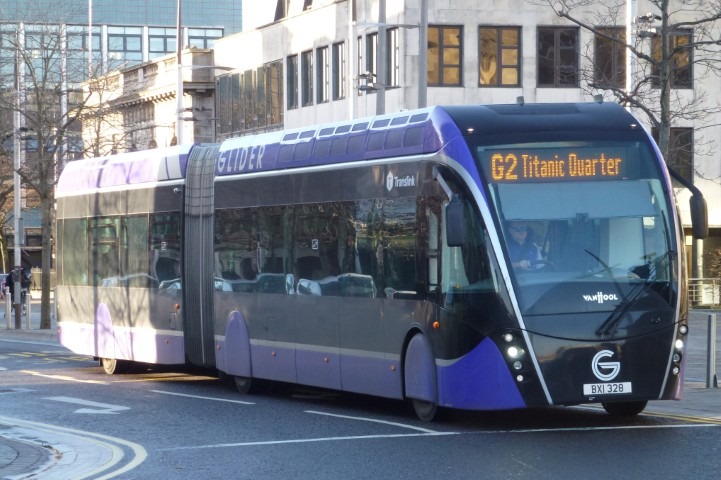
The G2 Belfast Glider at Custom House Square, en route for the Titanic Quarter.
What next for Glider? The Department for Infrastructure has conducted consultations over the next phase of Glider, which essentially envisages the extension of the Glider to serve North and South Belfast. However, full funding is not currently available for the complete scope of this project, so in the short term, the next stage will involve an extension of the G2 route to the South, South West to connect the existing route from City Hall to Belfast City Hospital and Queens University.
The Minister for Infrastructure announced this investment in February 2025, indicating that it will include £48 million of funding to finance the extension of the G2 route, as well as providing money to trial four electric vehicles on the Glider G1 corridor, releasing existing buses for the G2 extension. The £48 million will also fund various bus priority routes along the extension and in the city centre.
Finally, pictured below are the tickets that I bought, including the reusable and rechargeable plastic “daylink” card, ideal for visitors to the city.
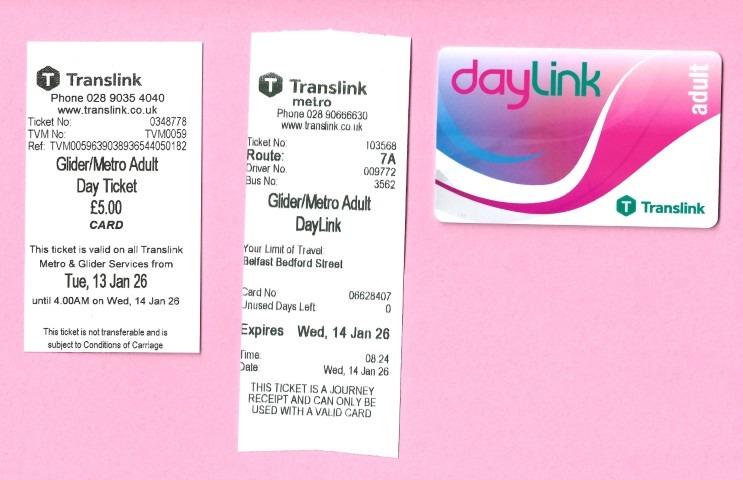
A combined Belfast Glider and Belfast Metro day ticket (£5.00) available from a Bus Halt ticket machine. The plastic “daylink” card was available from the Translink information centre, pre-loaded with £5.00. When used on a Metro bus, the ticket machine issues a ticket. At Glider bus halts the card reader is at the stop (not on the bus).
Finally, I confirm that the photographs are my own original work and have not been subject to any artificial manipulation, other than marginal cropping of the size of the image from the original pictures.
Sources I consulted for this article included: Nestrans Board Meetings (notably of 10 February 2021, amongst others); background information available on the website of the Northern Ireland Department for Infrastructure; and technical details on the Glider vehicle on the residual website of the manufacturer, Van Hool. I also looked at newspaper articles at “Wales Online” for reports on the Swansea FTR Metro.
Steven Ardron
25 January 2026