In 2026, the Munich public transport company – Münchner Vekehrsgesellschaft mbH (MVG) – marks the 150th anniversary of the introduction of the very first Munich Tram in 1876. So what better time to visit Munich and to try out the current tram network!
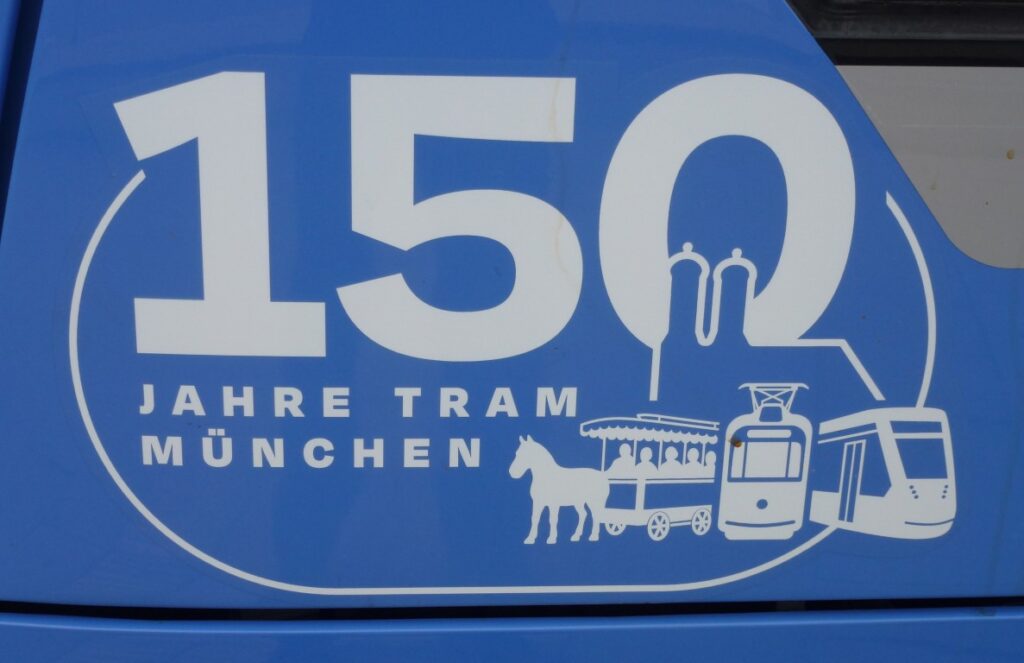
The commemorative logo celebrating the 150th anniversary of the first Munich tram, as affixed to one of the fleet of trams. The logo also features on the flag at each of the tram halts.
MVG operates the trams, buses, underground (U-Bahn) within Munich city. The MVG is one element of the Munich region transport alliance – Münchner Verkehrsverbund (MVV), which manages public transport in the Munich region as a whole, including the suburban railways (S-Bahn) and the regional trains (RegionalZug). The MVV produces maps, timetables and fares information for the MVG, as well as similar material for the operators who run the suburban buses under the MVV umbrella and brand. More on this publicity below, but first to the trams and the 150th anniversary.
The current MVG tram network has 12 routes: 12, 14, 16, 17,18, 19, 20, 21, 23, 25, 27 and 28. Of these routes, five run either north to south or east to west, and across the city centre (16, 17, 18, 19 & 21). Four routes operate from a fixed point in the city centre and fan out into the outer districts of Munich (20, 25, 27 & 28). Three shorter routes (12, 14 & 23) work in the outer districts alone. Monday to Saturday, the trams broadly run at high daytime frequency (every ten minutes) and at a reduced frequency on Sundays and bank holidays (every twenty minutes). There are four night trams, operating between 1.00am and 4.00am – N17, N19, N20 and N27. These routes broadly work on the same alignment as their daytime equivalents. According to MVG’s M-PULS newsletter (1/2026), the longest route on the network is provided by tram 17, which runs from Amalienburgstrasse in north west Munich to St Emmeram in the north east. This route is some 16.8 kilometres long, for which the journey duration is timetabled at a precise 57 minutes.
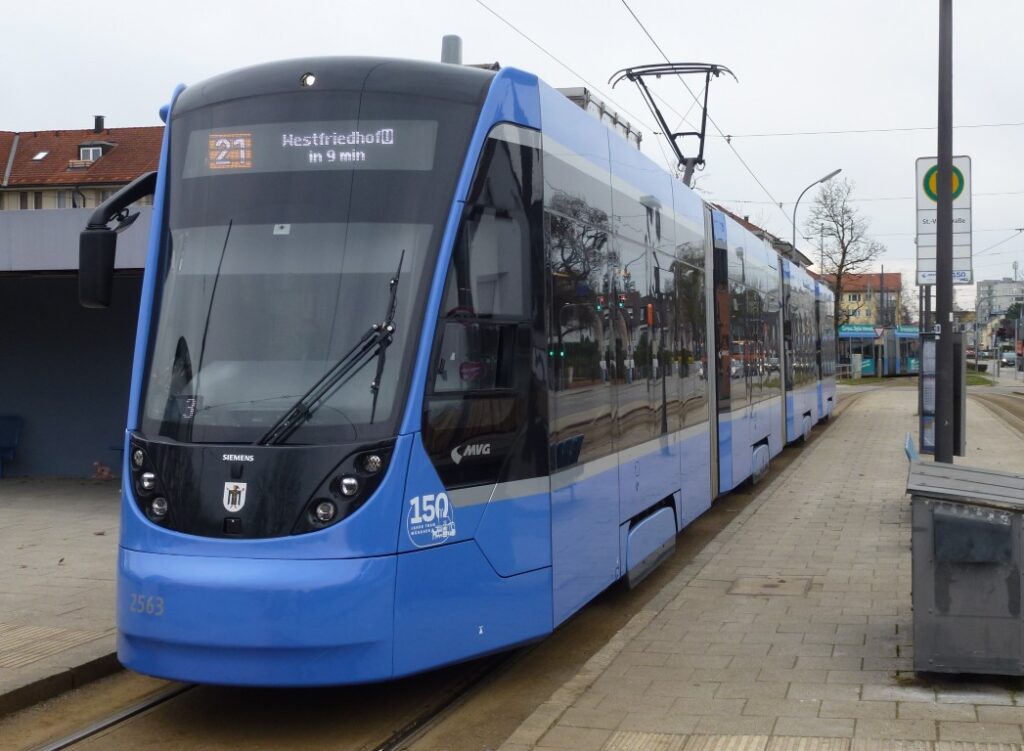
Tram 21 runs from Westfriedhof U-Bahn station to the west of Munich to the St-Viet-Strasse in the east, through the historic city centre. Here the tram is at the St-Viet Strasse terminus, interchange with local bus 195.
For the 150th anniversary of the Munich tram, MVG have produced a commemorative booklet (in German, of course) freely available at U-Bahn stations (by the ticket validators) and at the information centres located in the subways at the main station (Hautbahnhof), at the S-Bahn station at Marienplatz and at Munich East (Ostbanhhof). Notable in the content is the inventory of the tram rolling stock that has operated in Munich since 1876 to modern times.
MVG have also produced a leaflet that advertises a festival weekend which will take place over the weekend of 17-18 October 2026. This celebration will include a parade of historic tram vehicles; and an open day at the tram depot. MVG have given two of the modern trams an external make-over, giving them liveries that mimic trams of the past. To mark the importance of this milestone, MVG is vigorously promoting the 150th anniversary, with posters at tram stops, bus stops and at U-Bahn stations, as well as an article in the public newsletter MPULS (1/2026).
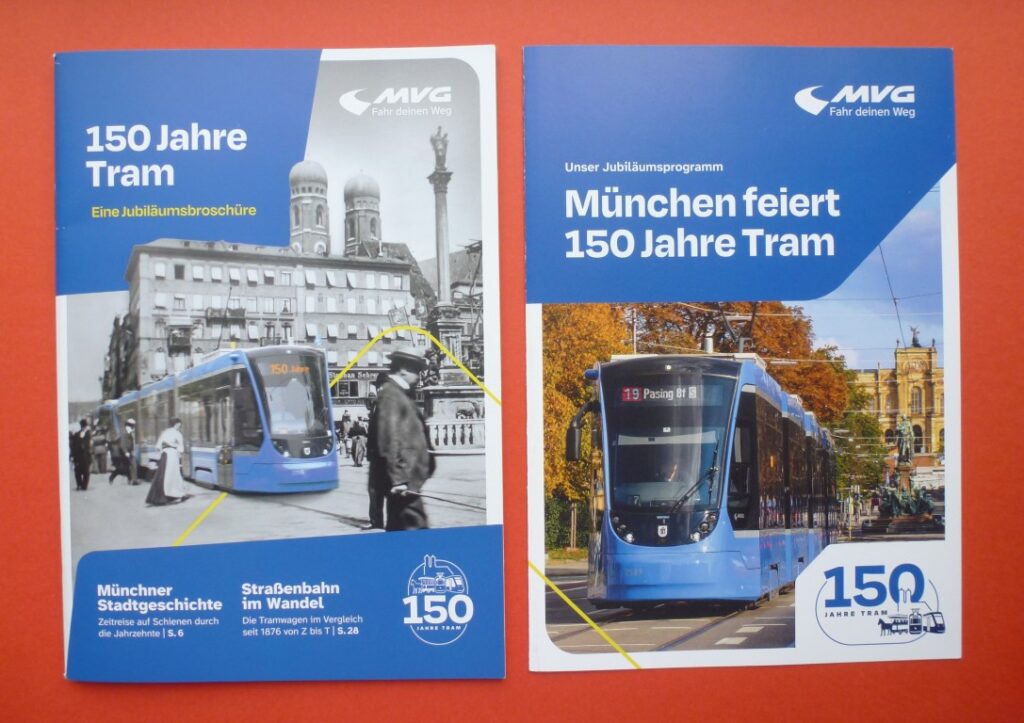
The commemorative booklet issued by MVG to celebrate the 150th anniversary of the Munich tram, alongside the promotional leaflet outlining the events linked to the birthday event. The booklet is an excellent product, full of facts, figures, stories and photographs.
As previously mentioned, MVV handles the passenger information for the Munich region. The fares for the tram, bus, U-Bahn, S-Bahn and RegionalZug within the Munich region (central “M” zone surrounded by 12 other zones) are integrated into a single fare structure: one ticket can be used on multiple modes to get from A to B. MVV produce a handy system and fare zones map (available both on their website and on paper, A2 sized foldable to A5). As you would expect, MVV also has an online journey planner, but for those of us that prefer active journey planning, MVV also produce pocket-sized paper timetables for each tram, U-Bahn, S-Bahn and bus routes. The timetables for the trams helpfully include geographical maps of the route. The tram network also has its own network map (online only) and also produces an accessibility map for the trams, showing step-free access points. The range of online maps is wide and impressive.
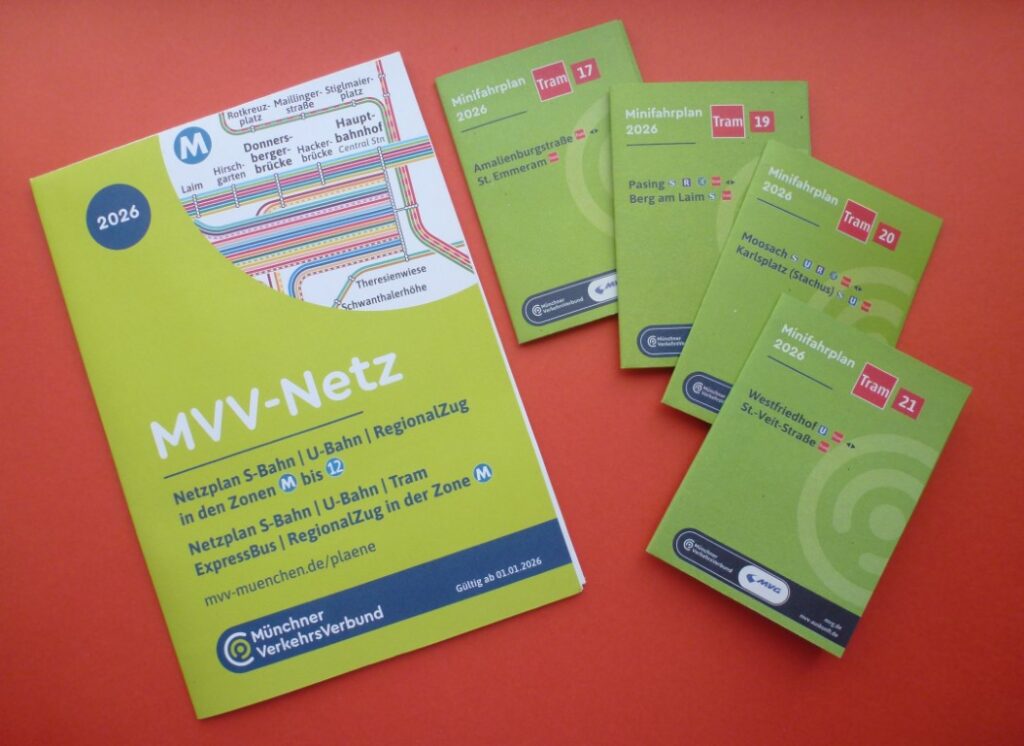
The MVV produced tram, U-Bahn, S-Bahn and RegionalZug network map (with English) alongside some pocket timetables for a sample of tram routes.
The MVG website which outlines the 150th anniversary plans is here:
https://www.mvg.de/news/150-jahre-tram.html
The commemorative brochure is available here to download in pdf, with English online translation of elements of the booklet.
The English version of the MVV website, with its tremendous range of network maps, is here:
https://www.mvv-muenchen.de/en/maps-stations/maps/index.html
The fact that this event is taking place – a celebration of 150 years of the tram in Munich (albeit that the first tram in 1876 was a horse-drawn affair) is cause for reflection on the state and progress of tramways in our own country. It is hard to think of a conurbation in the British Isles where the tram approaches such long continuous service, as in Munich, other than the obvious one of Blackpool; and Douglas, Isle of Man, where today the horse drawn tram continues to operate as a tourist route.
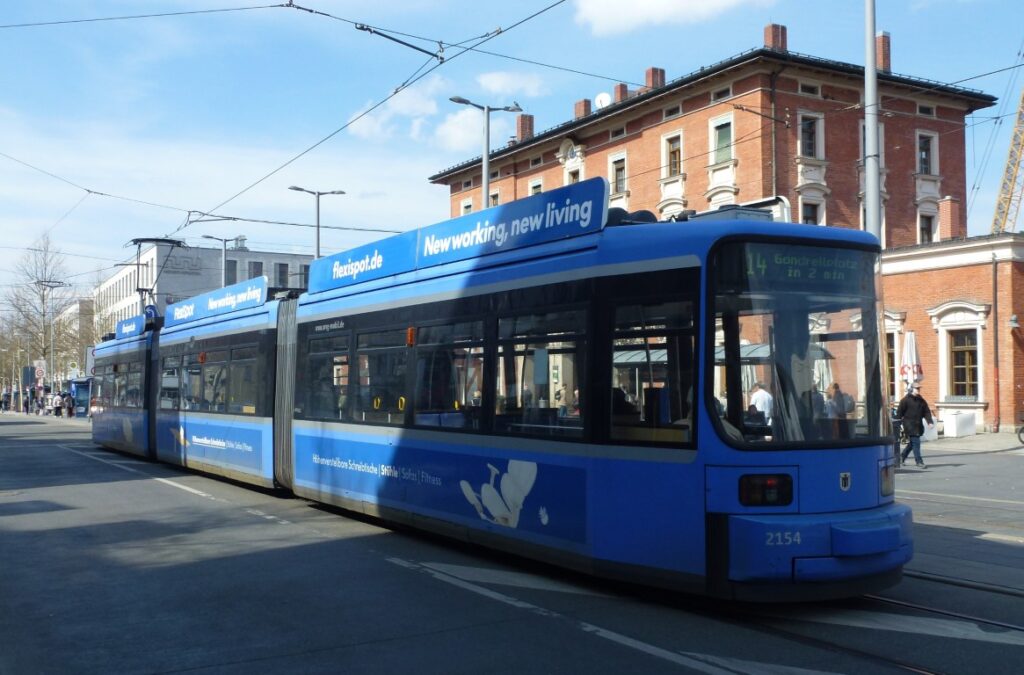
The rear of tram 14 at the Pasing terminus, just outside the railway station. This route is new to the network in 2026 and runs south to Gondrellplatz.
Finally, I confirm that the photographs are my own; I have simply cropped them for size.
Steven Ardron
5 April 2026